

How much of AI chat is actually shopping?
Somewhere between one conversation in fifty and one in five, depending on who’s counting. Both numbers are real, and the gap between them decides whether your customers find you.
DP Projects
5 min read
Get Found
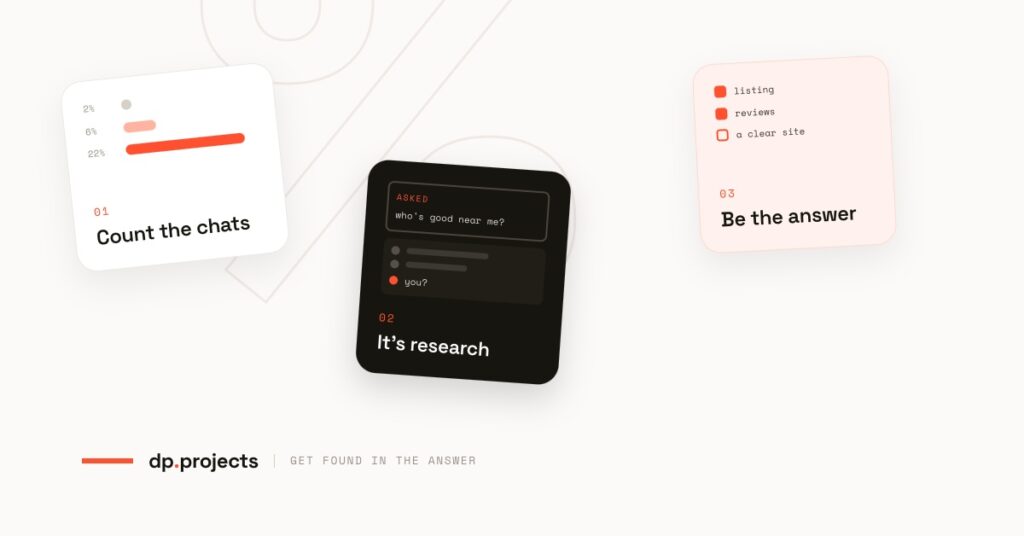
Count the chats. Know it’s research. Be the answer.
Ask four research teams how much of AI chat is about shopping and you’ll get four answers. OpenAI’s own study says about 2%. A marketing analytics firm says 19%. A consumer panel says 22%.
None of them is wrong. They drew the line in different places, and where they drew it tells you a lot about how your next customer will find you, or won’t.
Here’s what the data says today, where it’s heading, and what a small business can do about it this week.
A small share of the chats. A big share of the decisions.
Why the AI shopping statistics disagree
OpenAI’s 2025 study of how people use ChatGPT is the narrowest count. It looked only at messages about purchasable products and landed on roughly 2%. If “buying” means “which kettle should I get,” that’s your figure.
Widen the definition and the number climbs. BrightEdge, studying prompts where ChatGPT cited its sources, put comparison and ready-to-buy prompts at about 3% each. Profound classified 7.5 million conversations and found 19.2% carried commercial intent by mid-2026. Measure Protocol, working from a consented panel of real users, found 21.6% showed some buying signal, and 7.1% a strong one.
For a business owner, the wider number is the one that counts. Nobody types “buy electrician.” They ask who’s reliable, who’s local and who’s worth the money. That’s what ChatGPT commercial intent actually covers, and it’s already a large slice of a very large pie.
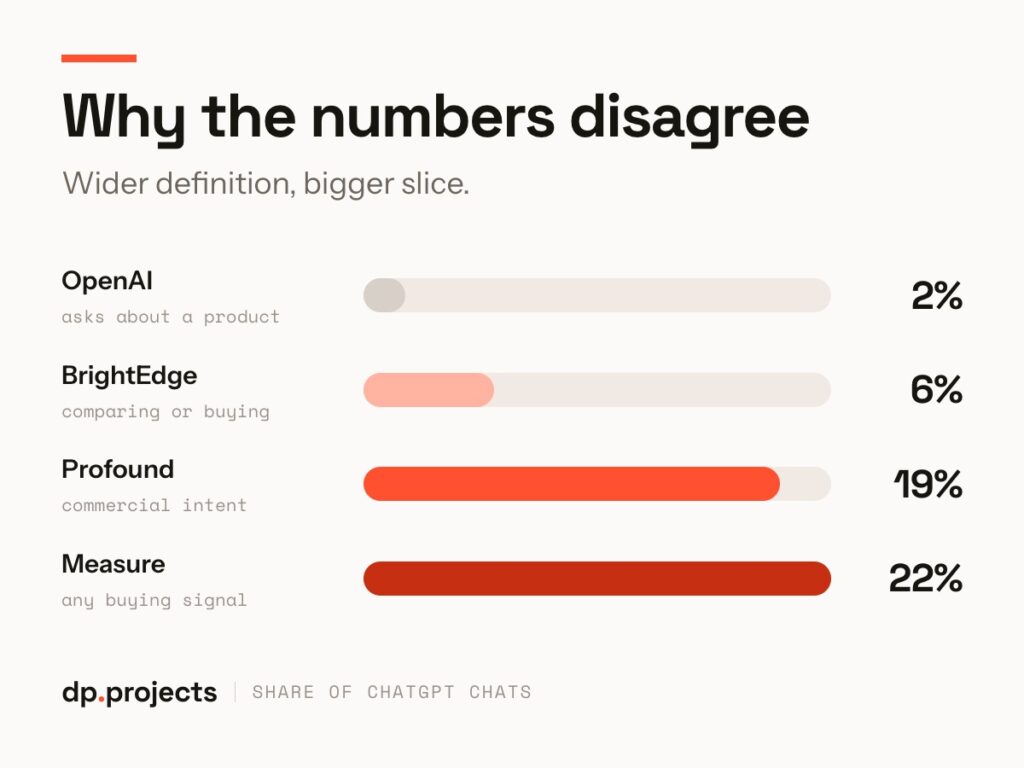
Same platform, four definitions of “shopping.”
Where it’s heading
Every serious dataset points the same way. Profound’s commercial share rose 5.3 points in twelve months. Because overall use grew at the same time, the weekly number of buying conversations more than doubled, from an estimated 243 million to 533 million.
The traffic follows. Adobe measured AI referrals to US retail sites up 693% over the 2025 holidays and 393% in the first quarter of 2026, and it forecasts another 130% rise this holiday season. In March 2025 those visitors converted 38% worse than other traffic. A year later they converted 42% better.
The long-range forecasts are about AI doing the buying as well as the research. Bain expects AI agents to account for 15–25% of US e-commerce by 2030; Morgan Stanley says 10–20%. Nobody has published a credible forecast for the share of chats itself, so be wary of any single 2030 number you see quoted. The direction isn’t in doubt.
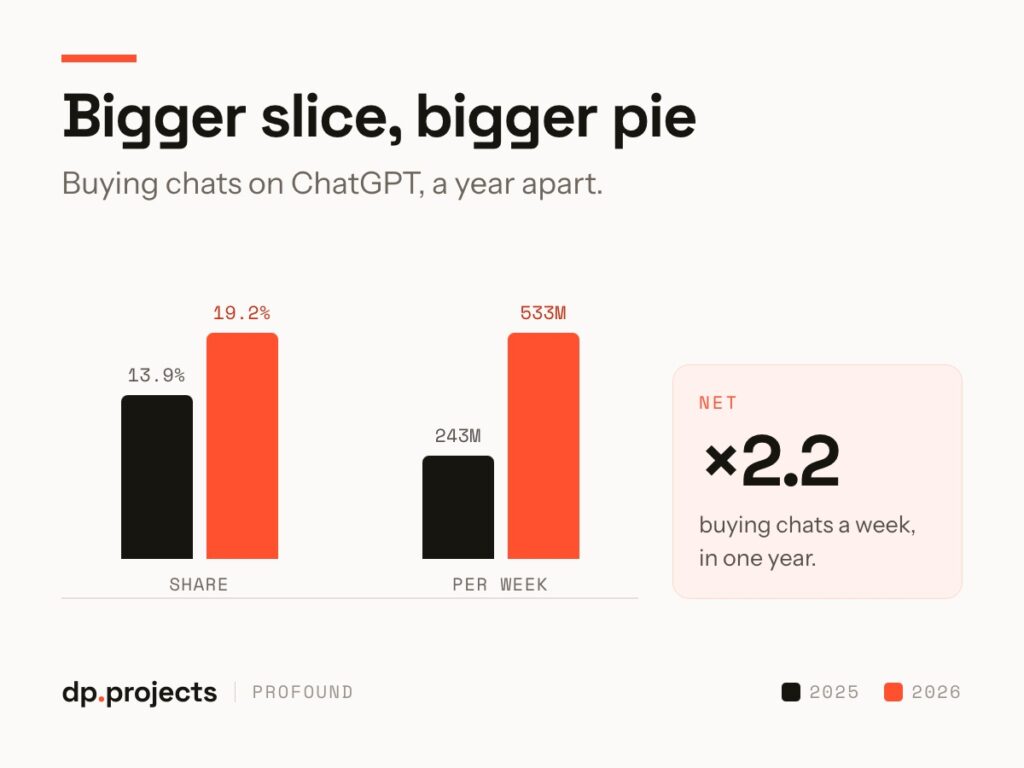
The slice grew. The pie grew faster.
The chat makes the shortlist. You still have to win it.
This is the part the headlines skip. Alchemer found 22.9% of shoppers now turn to an AI model when researching a purchase, but only 0.3% plan to buy through one. Product.ai found 86% of people who used AI for product research checked its answer somewhere else before buying. And Semrush found that the same share of AI users, 58%, have bought on a chatbot’s recommendation as have walked away because of something it told them.
So the AI works like a gatekeeper. It builds a shortlist from whatever it can find and read about you: your Google listing, your reviews, your website, what other sites say. Then the customer goes and checks. Miss either step and you’re out of the running.
There’s good news for local firms in BrightEdge’s data, too. Where ready-to-buy prompts do appear on ChatGPT, they lean towards local services and dining.
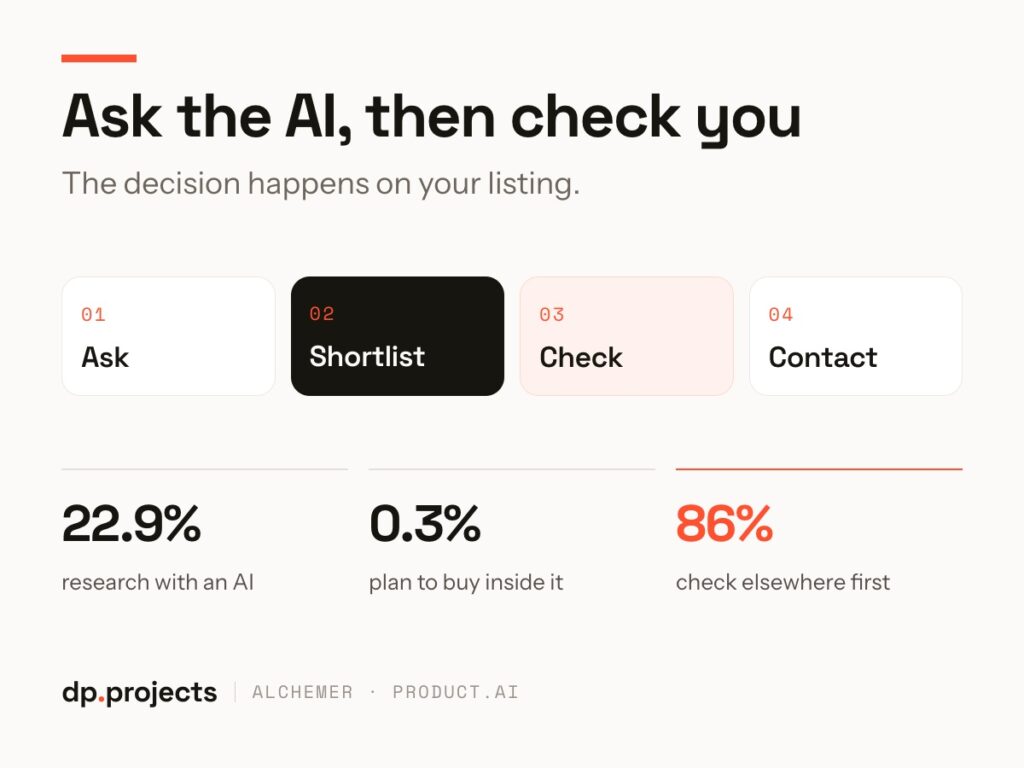
Research happens in the chat. The decision happens on your listing.
What it looks like for a real business
We recently audited a local cabling business. Its competitors came up easily, both in search results and in AI assistant answers. It didn’t come up in either. There was no Google Business Profile, no reviews, and no website that said clearly what it did and where.
None of that called for a redesign. We recommended three things: set up the profile, build a simple site, and start asking customers for reviews. That work is under way, and we’ll share what changes once there’s something to report. What stood out was how ordinary the gaps were.
Three things to check this week
Getting found by AI assistants starts with the same basics people already check.
Whether you believe the 2% or the 22%, the share is only moving one way, and the customers using it arrive closer to a decision than any search visitor did.
Start with the first check. Ten minutes asking the questions your customers ask will tell you more than any statistic in this article.
Your next client will be asking AI how to find you.
Get Found is how we make sure your name is in the answer, and that what they find when they check holds up.