


How will AI change business? What to do first
AI is turning into the layer between your data, your team and your customers. The businesses that gain most will be the ones that know which job they want it to do.
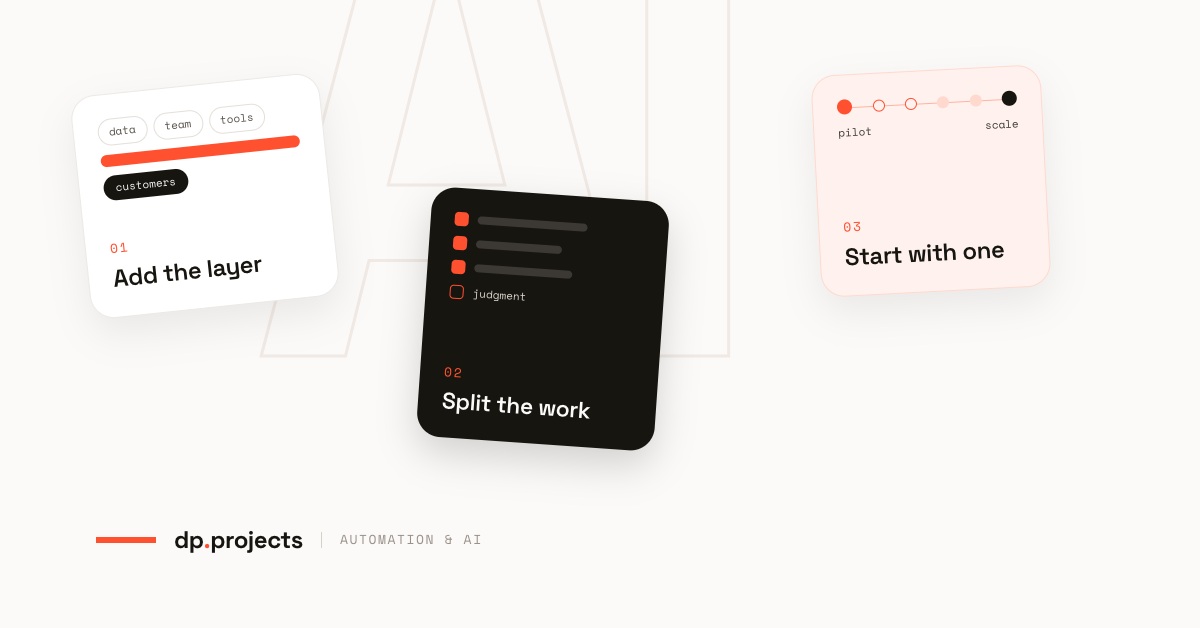
Add the layer. Split the work. Start with one.
People ask how AI will change business as if the answer were one big event. In practice it’s a lot of small ones. A summary waiting for you before a meeting. An invoice read and filed without anyone typing it in. A customer question answered at 11pm and handed to a person in the morning, with the context attached.
For a company of 5 to 100 people, that’s the interesting part. None of it needs a research lab, so the advantage goes to whoever sets it up well.
Here’s how we see the shift, what tends to get automated first, and a seven-step way to start without wasting a budget.
AI is moving from side project to everyday plumbing.
AI becomes the layer in between
Most businesses run on a stack of separate tools: a CRM, an accounting package, a shared drive, a support inbox. AI is starting to sit across them. It reads what’s in each one, connects it, and hands back something useful: a summary, a flag, a recommendation, a first draft.
Some systems go further and chain the steps together. Research a prospect, draft the proposal, update the CRM, book the follow-up, then wait for a person to approve it. That’s what people mean by AI agents, and versions of it already ship in tools small teams use.
The catch is that the layer is only as good as what sits underneath. If your client details live in three spreadsheets and an email thread, AI will summarize the wrong one with total confidence. Organized data is the unglamorous foundation of everything else here.
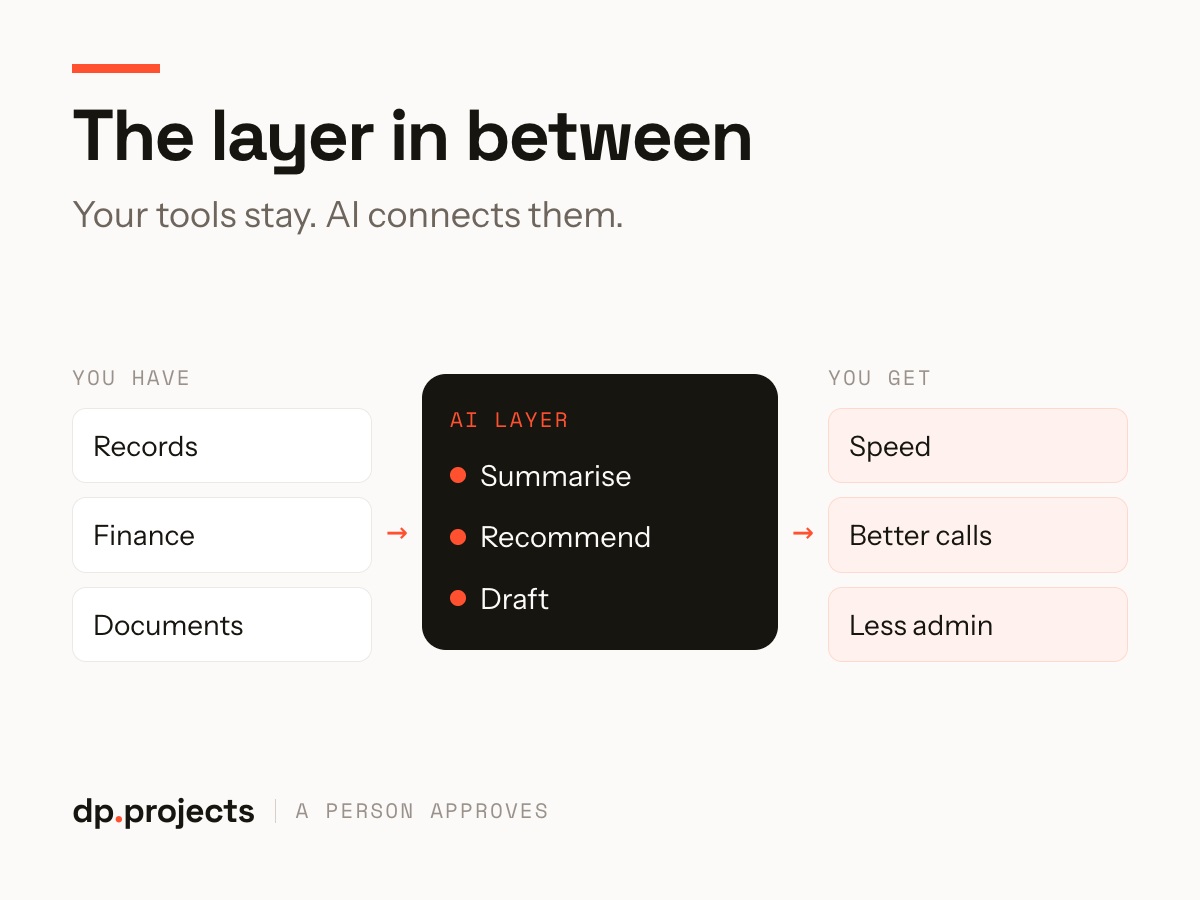
Your tools stay where they are. AI connects them.
What AI automates first, and what stays human
AI automation for small business starts with work that’s repetitive, digital and rule-based. It takes hours but little judgment: sorting enquiries, pulling details out of invoices and forms, checking expenses, writing up meeting notes, producing first drafts, watching systems for problems.
What stays human is the part with consequences. The final call. The client relationship. The odd case that doesn’t fit the pattern. Anything touching someone’s money, health, job or legal rights needs a person signing it off, whatever the software promises.
Before you automate anything, write the process down. Automate a messy workflow and you get the same mess, only faster and harder to see.
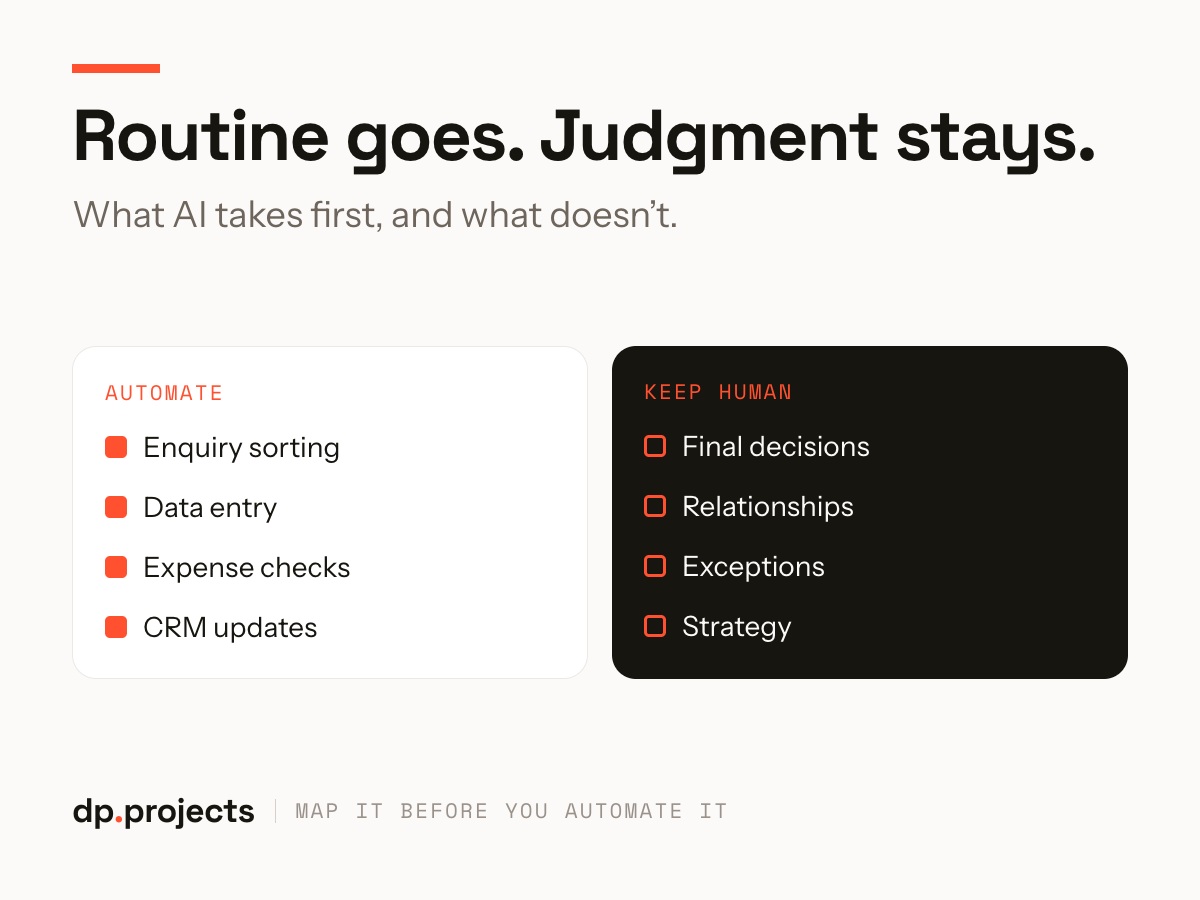
Automate the routine. Keep the judgment.
AI and the future of work: jobs change shape
AI will change the work inside most roles long before it changes job titles. An analyst models scenarios in an afternoon instead of a week. A recruiter spends less time sorting CVs and more time interviewing. An account manager gets a warning that a client is drifting before the client says a word.
The skill everyone needs is AI literacy: knowing what a tool can do, where it goes wrong, how to brief it and how to check what it gives back. Judgment, communication and knowing your field matter more, because every recommendation still needs someone who understands the context and owns the outcome.
Train people on real tasks from their own week rather than generic courses. And tell them plainly why you’re bringing AI in and how you’ll judge whether it’s working. That does more to settle nerves than any memo.
Better decisions, better customer experience
AI can weigh more variables than anyone can hold in their head: sales history, supplier reliability, seasonality, the tone of last month’s complaints. It turns that into options, and someone still has to choose. Data goes stale or skews, and a model can sound certain about something it got wrong. Ask where the data came from, and keep a record of who approved what.
For customers, the change shows up as speed and relevance. Support that answers at any hour and passes complex cases to a person with a summary attached. Suggestions based on what someone actually did. A check-in when a new customer gets stuck, before they give up.
Be open about it. Tell people when they’re talking to AI, collect only the data you need, and keep a human easy to reach. Judge it on resolution and retention rather than tickets closed. A fast wrong answer costs more than a slow right one.
AI readiness in seven steps
Start with a business problem, not a tool. The useful question isn’t how AI will change business in general. It’s where it can make a measurable difference in yours.
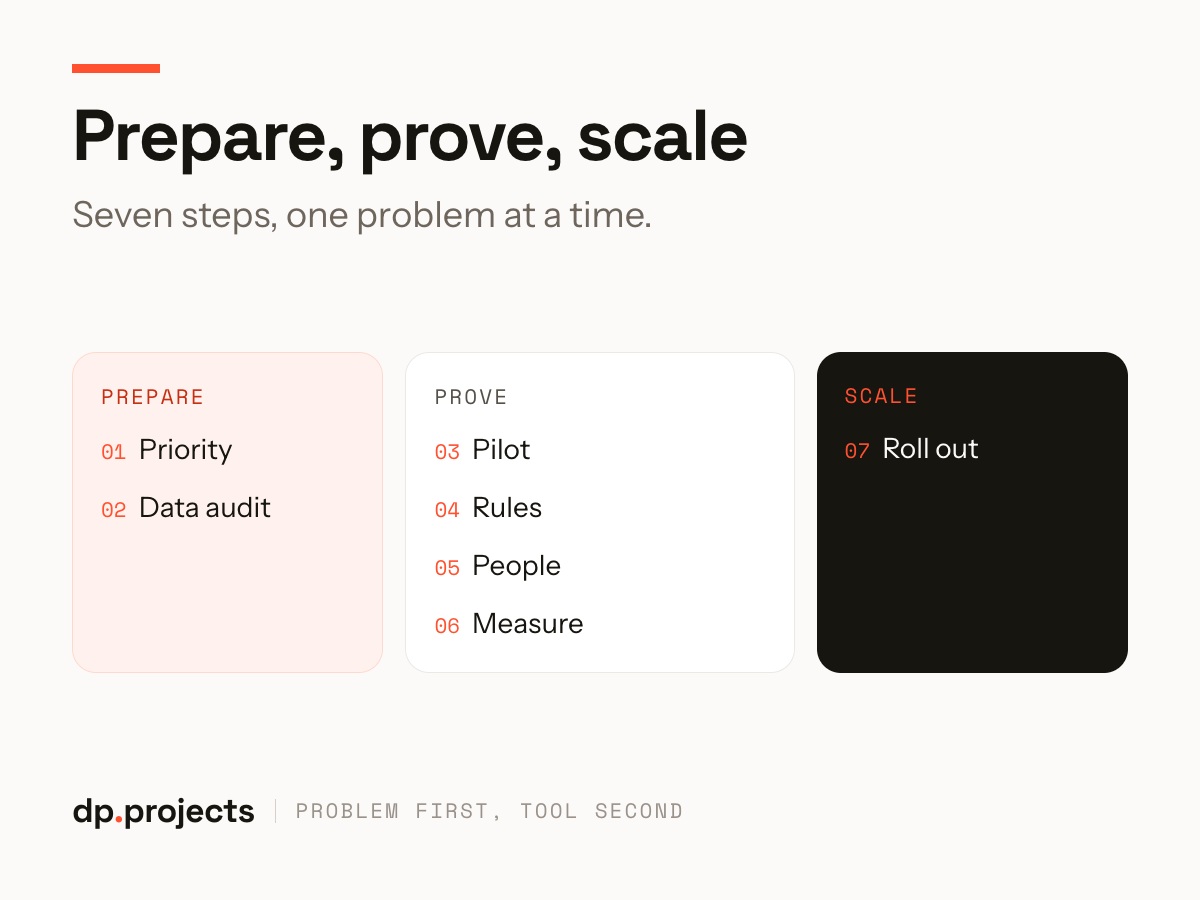
Prepare, prove, then scale what earns it.
The tools will keep improving and competitors will keep finding new uses. The teams that adapt fastest won’t be the ones with the most software. They’ll be the ones with organized data, clear processes and a habit of testing small.
Pick one task that eats hours every week and write down how it works today.
That’s your first pilot.
Is your data ready for any of this?
We’ll map where AI fits your workflows, what needs organising first, and the one pilot worth running.