



Where Work Goes to Die On Your Team
It isn’t briefing, drafting or review. It’s the space between them, where a job is finished by one person, not yet accepted by another, and owned by nobody at all.
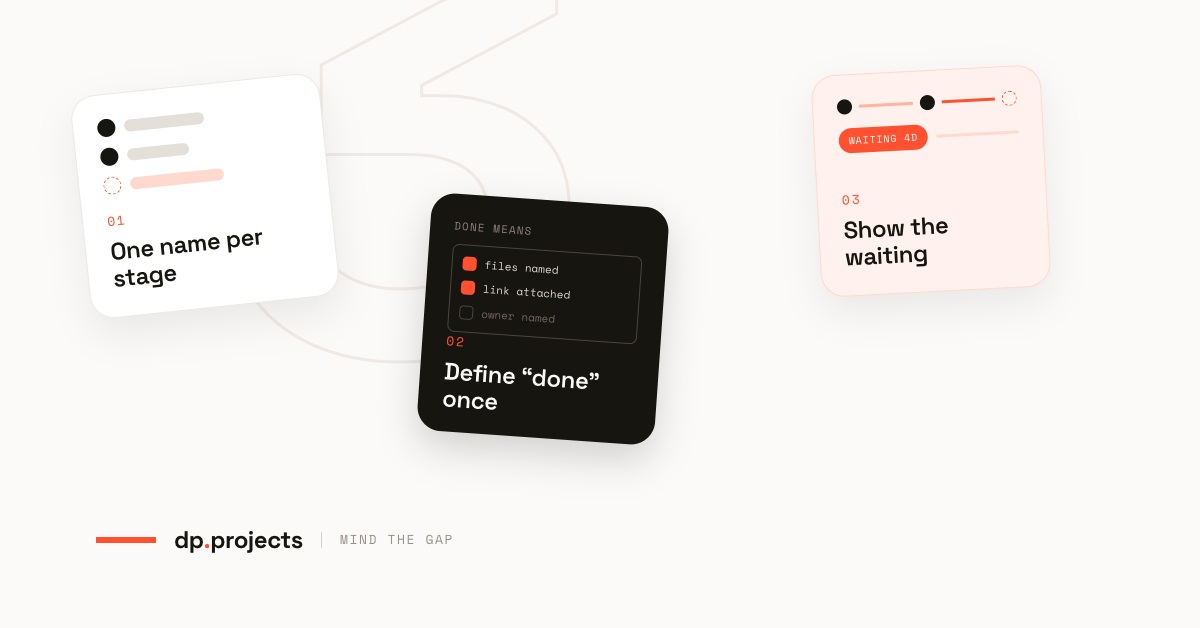
One owner. One definition of done. Waiting you can see.
After observing several clients over months: where does work go to die on your team? Briefing, drafting, review, sign-off. The votes were not evenly spread, and they never are.
It’s the handoffs. It’s almost always the handoffs.
Look at any job that took three weeks longer than it should have and you will rarely find someone being slow. You will find a Tuesday where the draft was finished, and a Saturday where review picked it up, and four days in the middle where the work belonged to nobody. Nobody missed a deadline, because there wasn’t one for the gap.
The good news is that gaps are cheap to fix. You don’t need new software or a change of culture, you need three agreements about what happens at the point of transfer.
Same people. Same work. Half the calendar.
Give every stage one name, never a team
“Design has it” is not an owner. Neither is a shared inbox, a channel, or a column on a board. When a stage belongs to a group, everyone who looks at it makes the same reasonable assumption, that somebody else has already picked it up and the work waits politely for a volunteer.
One person per stage, written down where the work lives. That person doesn’t have to do it all; they have to be the one who notices if it stops. Ownership is about attention, not labour.
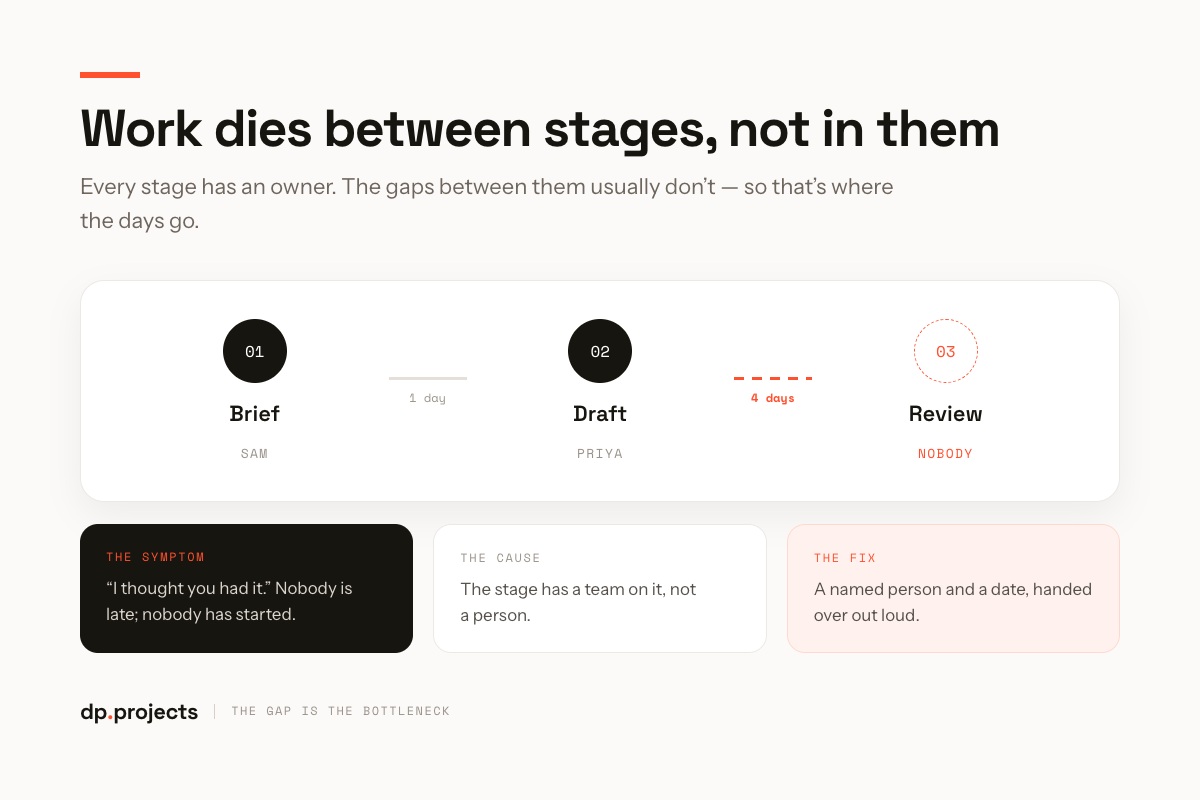
Stages have owners. The gaps between them usually don’t.
Agree what “done” means before you need it
Most handoffs fail because the two people either side of it are using different definitions. One means “I’ve stopped working on it.” The other hears “it’s ready for me.” Those are not the same sentence, and the difference is measured in days.
Write the definition down once, for the whole team. Ours is four things: the files are named properly, the link is in the ticket, the next owner is tagged, and there’s a date. Miss any one and the stage isn’t finished, it has only stopped.
This is also why a naming convention pays off twice: a handoff that points at 2026-09-14_acme_draft_v02 needs no covering explanation.
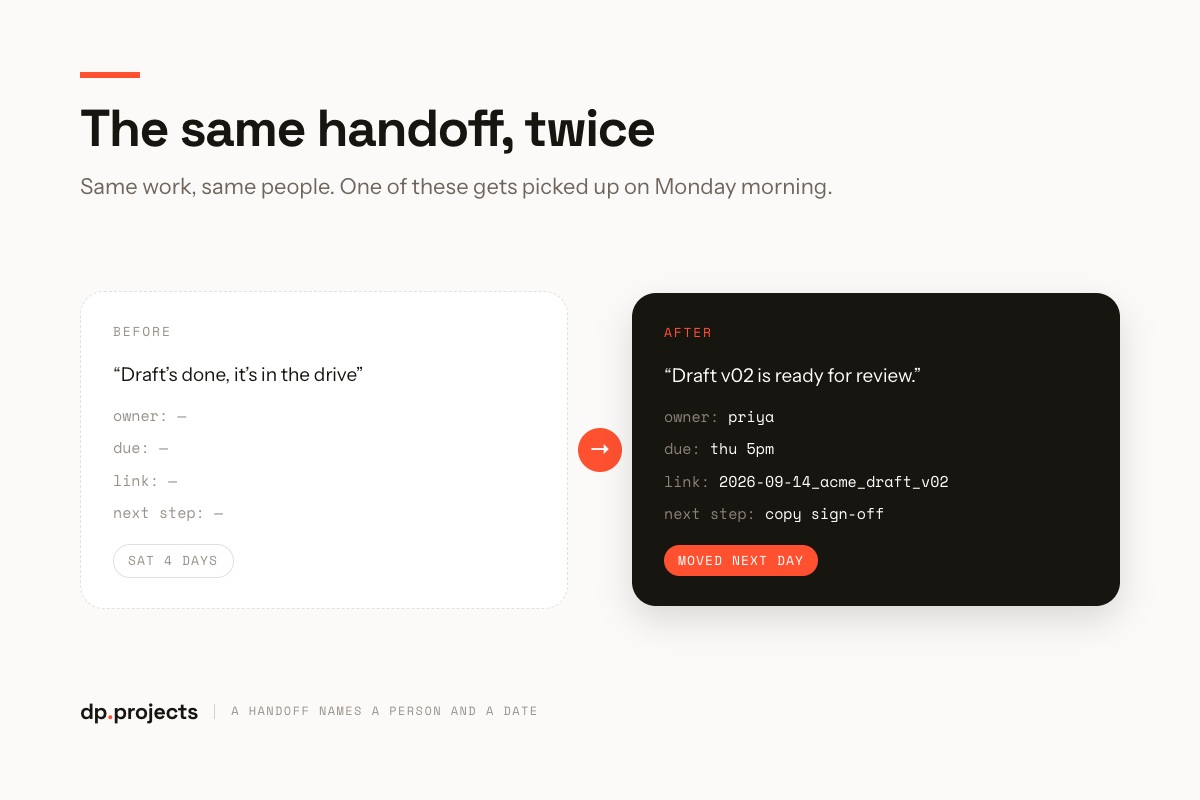
Same work, same people. One of these moves on Monday.
Make the waiting visible
Every project tool is good at showing who is working on what. Almost none of them show you how long something has been sitting still, which is precisely the number you need, because waiting is invisible by nature. Nothing goes red. No one gets an email.
Add a waiting state between your stages, or simply run one weekly filter: anything that hasn’t moved in three days. Five minutes on a Monday, and the gaps stop being anonymous. Teams almost always find the same two gaps, week after week, which tells you exactly where to spend the effort.
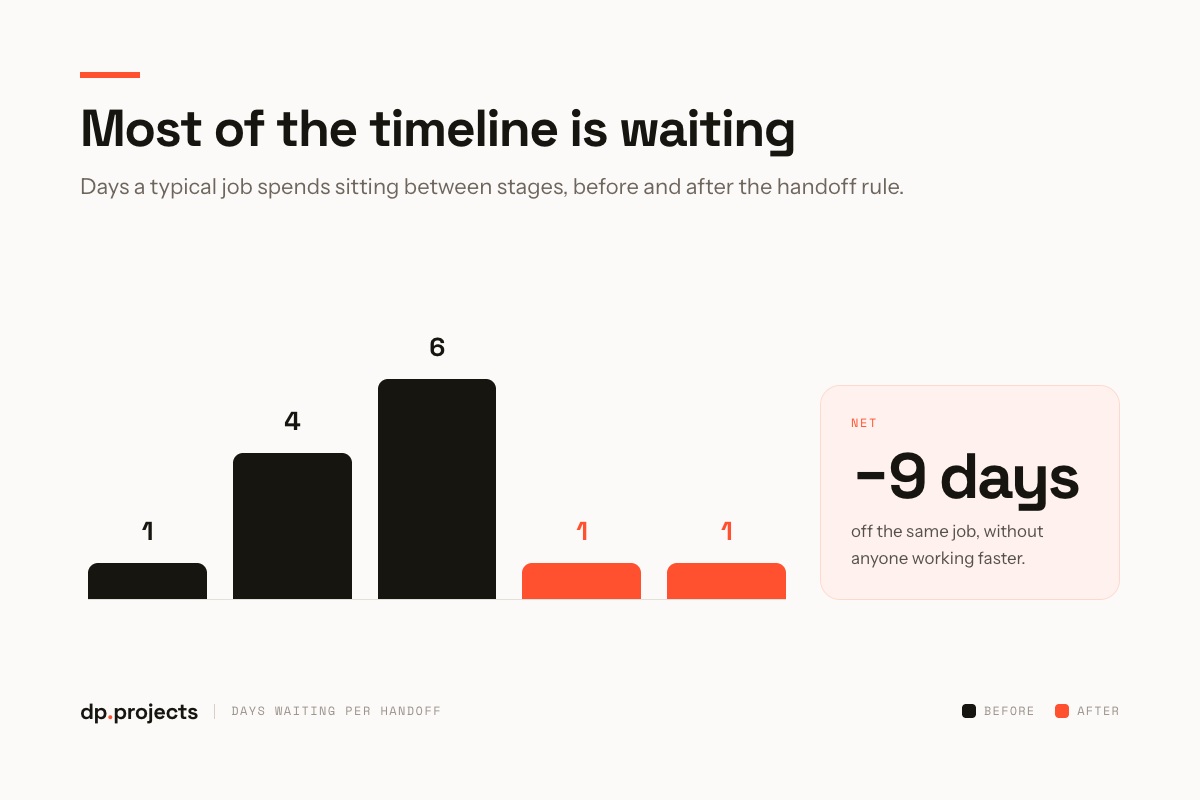
Days spent waiting between stages, before and after.
What actually changes
Nobody works faster. That is the part worth saying plainly, because it is the part that makes this worth doing: the gain comes entirely from time the work used to spend belonging to no one.
The second thing that changes is quieter. When the handoff carries a name and a date, chasing stops being someone’s job. Nobody has to be the person who asks. That is worth more to a small team than the nine days.
Three rules that stop this backfiring
Process fixes fail in predictable ways. These three keep a handoff rule alive past the first busy fortnight.
Take one job that ran long and mark where it actually sat, not who was slow, where it waited. Then give that one gap a named owner, a definition of done, and a date.
Start with whichever gap annoys you most. It is usually the one you have already stopped complaining about.
Is it the handoffs, or the shape of the process?
We’ll map how work really moves through your team, find the gaps it sits in, and rebuild the handoffs with you.