

Email etiquette that actually gets replies
Most emails aren’t ignored because they were rude or too long. They’re ignored because the reader couldn’t work out what they were being asked to do. Three habits fix it, and none of them are about being polite.
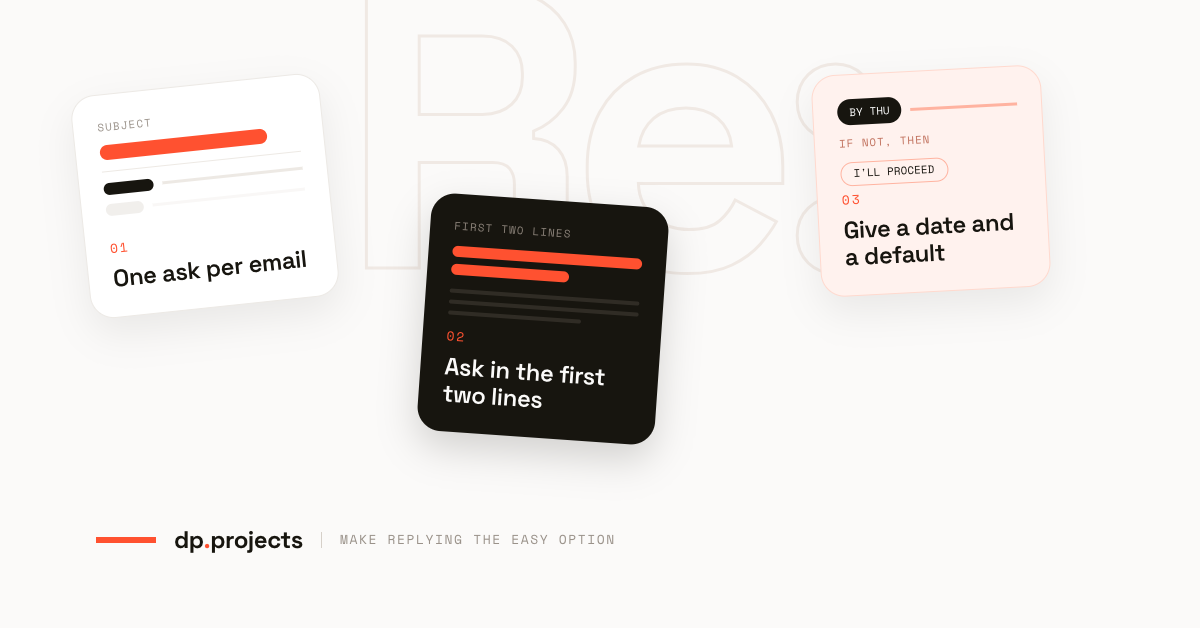
One ask, stated early, with a date attached.
There is a specific silence that follows a certain kind of email. You wrote it carefully. You were friendly, you gave context, you said “just checking in” instead of anything demanding. And nothing came back.
The instinct is to blame the recipient, or to blame the medium. In our experience it is almost always simpler than that: the reader could not tell what they were supposed to do, or by when. So the email became something to deal with later, and later never arrived.
Good email etiquette is not about softening your language. It is about making the reply cheap. Three habits do nearly all of the work.
They are scanning, not reading. Design for that.
One ask per email, and put it in the subject
If you need three things, send three emails. It feels like more work and more noise, and it is neither, a message with three requests in it typically comes back with one answered, which means you are now chasing the other two anyway.
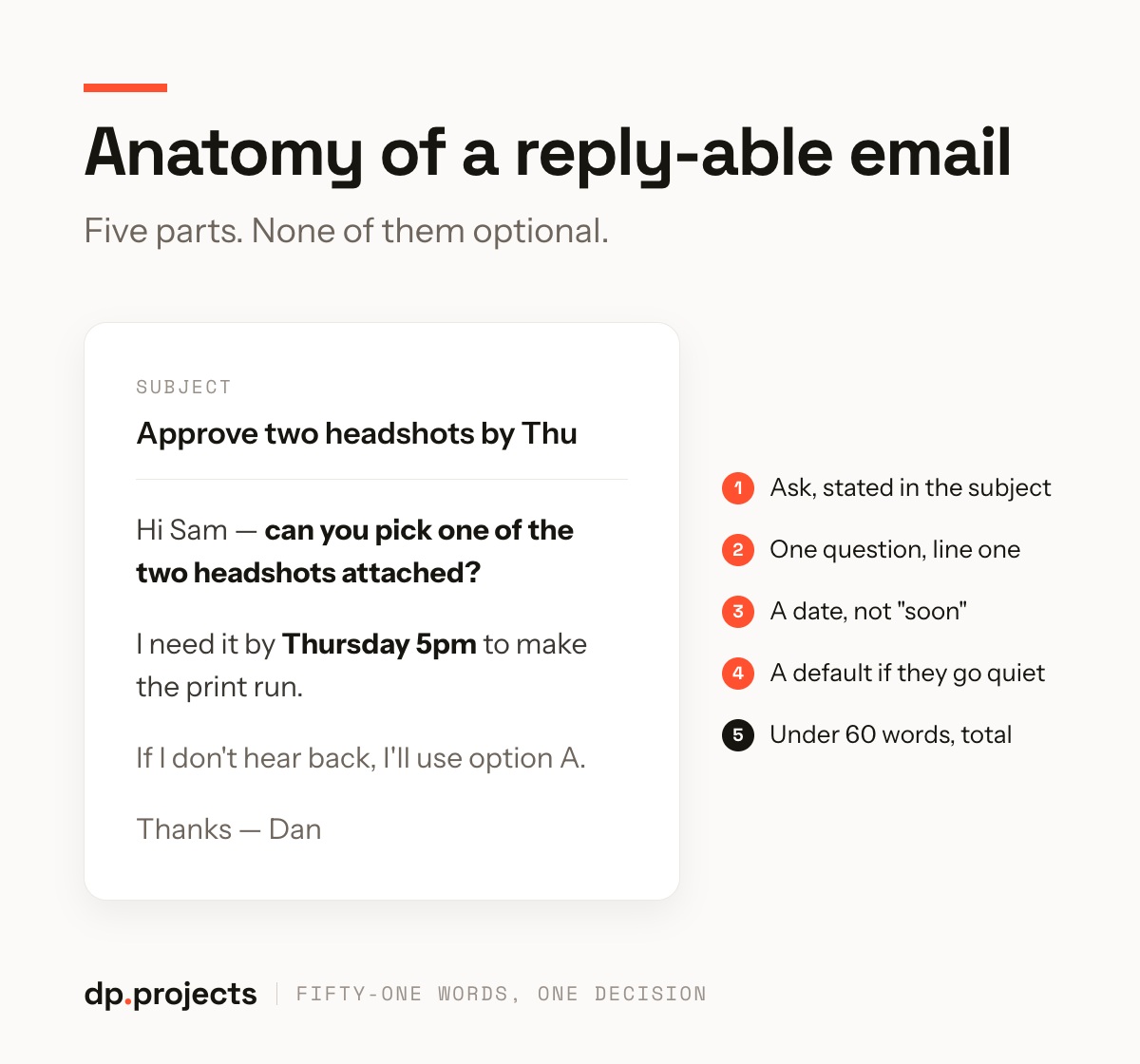
Then write the subject line as the ask, not the topic. “Approve two headshots by Thu” tells the reader what this is and what it costs them. “Quick catch up” tells them nothing, and quietly signals that it can wait.
A good test: if your subject line could be used for any of the last five emails you sent that person, it’s not really adding value.
Lead with the ask, then explain
Most of us were taught to build up to the request: context, background, reasoning, and then finally the question. That order is fine in a document and wrong in an email, because the reader decides whether to engage in the first two lines and your ask is on line five.
Invert it. The question goes first, in one sentence, ideally bolded. The context goes underneath, for the reader who needs it. Most won’t, they already know why you’re asking.
Give a date, and give a default
“When you get a chance” is not kindness, it’s ambiguity, and ambiguous things go to the bottom of the pile. A real date, “by Thursday 5pm”, lets the reader place your request against everything else they’re holding.
The part people miss is the default: “if I don’t hear back, I’ll go with option A.” It does two things at once. It removes the risk of your project stalling on someone else’s inbox, and it makes replying genuinely optional for anyone who is happy with option A.
Counterintuitively, this gets you more replies rather than fewer, because the people who do care now have a reason to speak up.
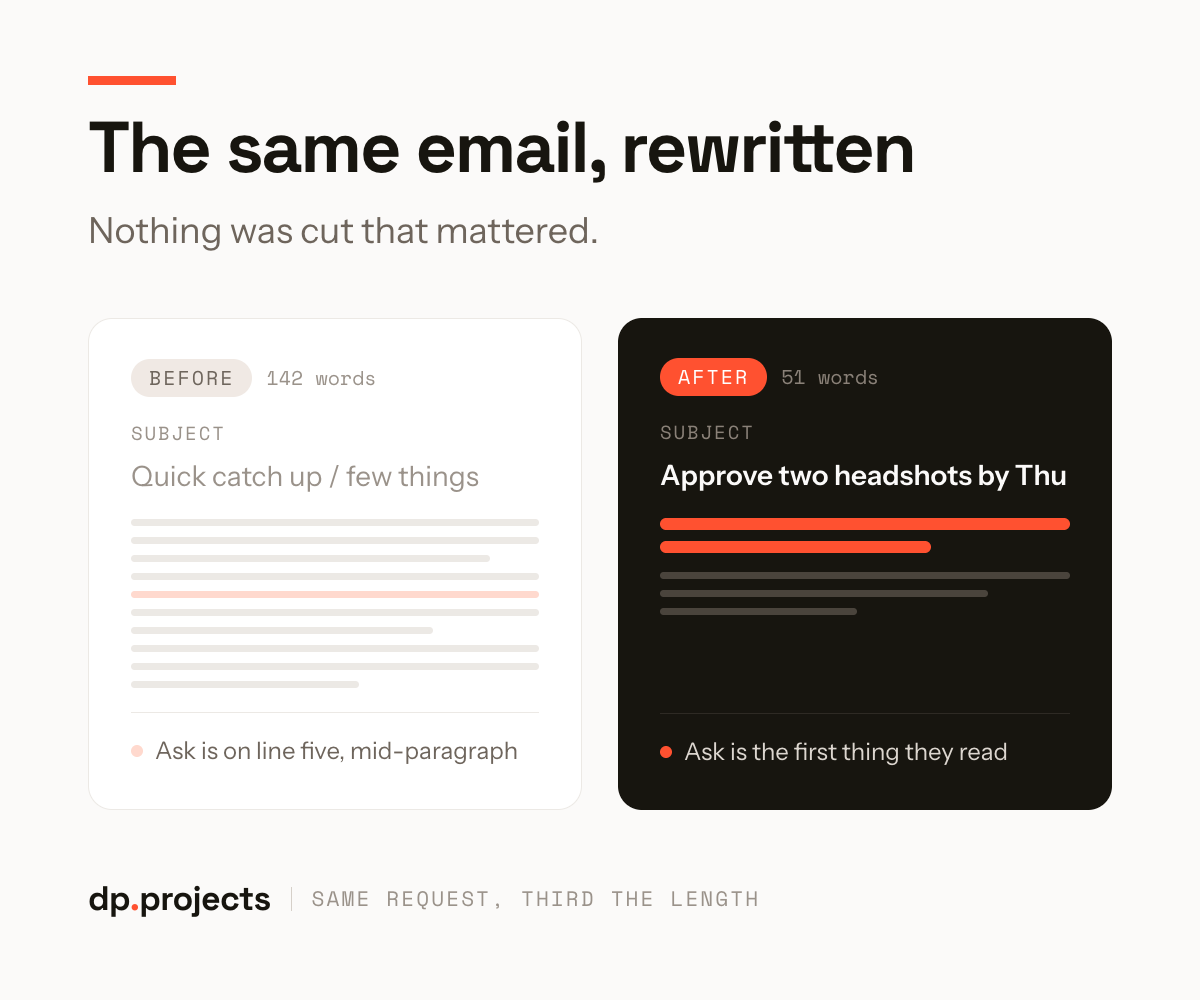
The same request, a third of the length.
What actually changes
You will not become more persuasive and you will not send fewer emails. What changes is the waiting: fewer threads sitting open for a week, fewer follow-ups that begin “just bumping this,” and fewer decisions that were never really contested sitting unmade.
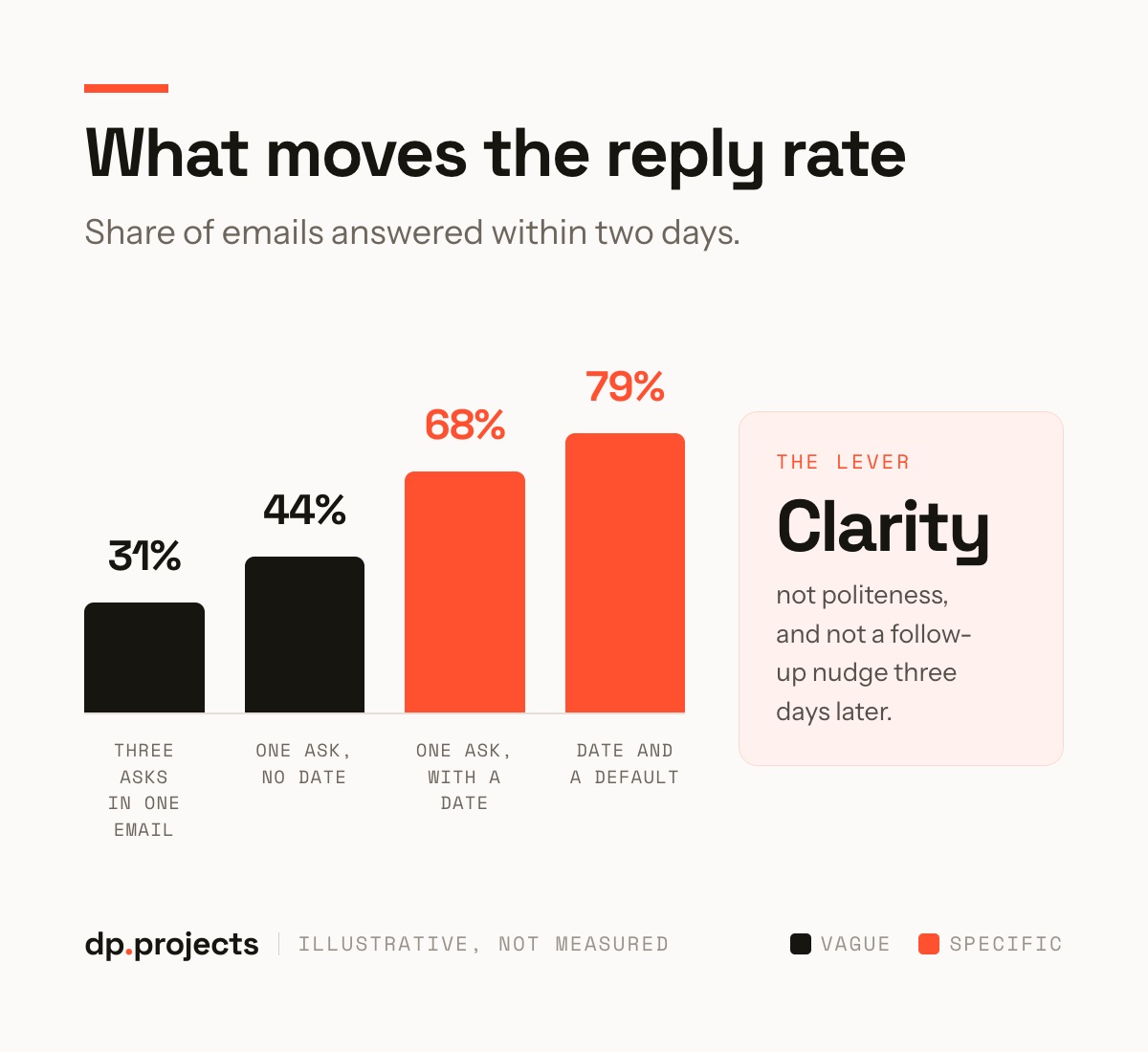
Clarity moves the number. Politeness doesn’t.
Three ways this goes wrong
Directness curdles into bluntness quickly. These are the guardrails.
Try it on the next email you’re tempted to open with “just checking in.” One ask, in the subject. The question in line one. A date, and what happens if they don’t reply.
It will feel abrupt to write and it will not read that way. The reply usually arrives the same day.
Still chasing the same approvals every week?
Then the problem is the process, not the wording. We’ll map where your work waits on people and build the requests into it.